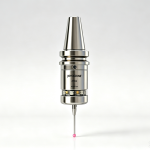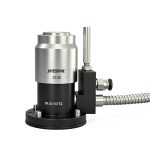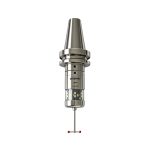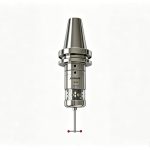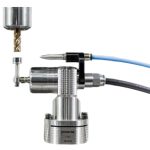
A mill touch probe (also called a CNC touch probe for milling machines) is a high-precision measurement device used on CNC machining centers to automatically determine the position, dimensions, and alignment of a workpiece or tooling. It plays a critical role in modern manufacturing by improving accuracy, reducing setup time, and enabling in-process inspection.

A mill touch probe is typically mounted in the spindle of a CNC milling machine and functions as a highly sensitive switch or sensor. When the stylus (the probe tip) makes contact with a surface, it triggers a signal that is sent to the CNC control system. The machine then records the exact position of the spindle at the moment of contact, allowing it to calculate geometric data such as:
- Workpiece zero position (X, Y, Z offsets)
- Surface location and orientation
- Feature dimensions (holes, bosses, edges)
- Tool length and diameter (when used for tool setting)
Main Components
A typical mill touch probe consists of the following components:
• Stylus
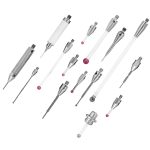
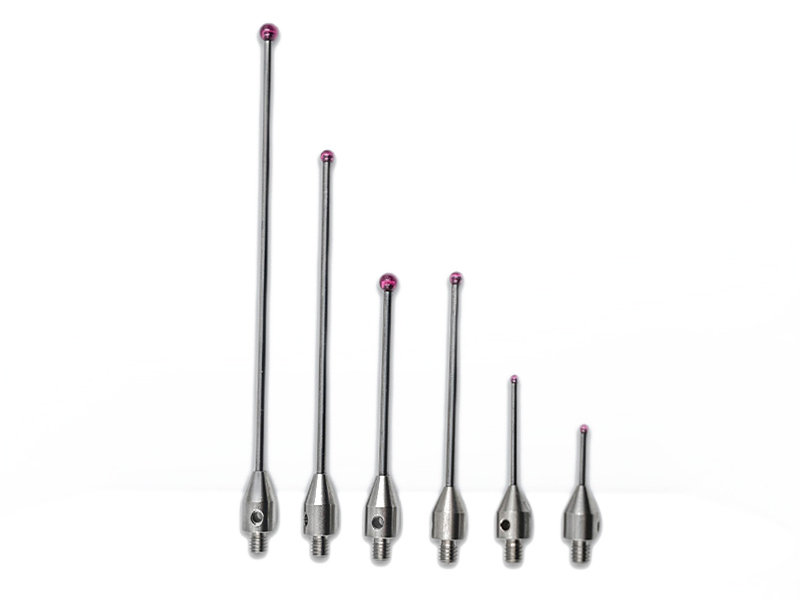
The stylus is the physical contact element, usually made of a ruby ball attached to a rigid stem. It directly touches the workpiece.
• Trigger Mechanism
Inside the probe body, a kinematic or strain-gauge mechanism detects deflection when the stylus contacts a surface. High-quality probes ensure repeatability in the micron range.
• Transmission System
Signals are transmitted from the probe to the CNC controller via:
- Radio (RF) transmission
- Infrared (IR) communication
- Wired connection (less common in modern machining centers)
• Probe Body
A robust housing that protects internal components from coolant, chips, vibration, and thermal variation.
Working Principle
The working principle of a mill touch probe is straightforward but highly precise:
- The probe is loaded into the spindle like a cutting tool.
- A probing cycle is initiated through CNC macros or software.
- The machine moves the probe toward the target surface at a controlled speed.
- When the stylus contacts the surface, the probe triggers instantly.
- The CNC system records the exact machine coordinates at the trigger point.
- Software calculates offsets, dimensions, or alignment based on these coordinates.
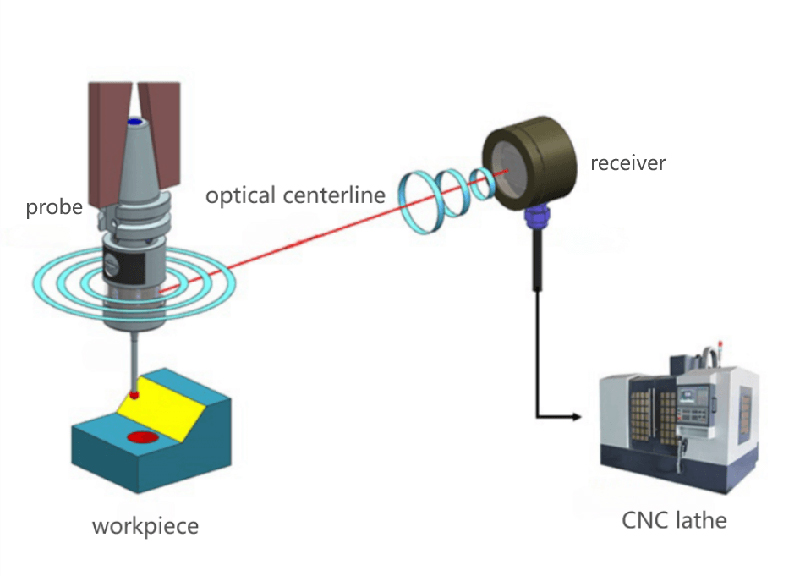
This process can be repeated across multiple points to build a complete geometric profile.
Key Applications
Mill touch probes are widely used in CNC machining for the following applications:
Workpiece Setup (Part Zeroing)
Instead of manually aligning parts, the probe automatically locates edges, centers, or surfaces, establishing accurate work coordinate systems (e.g., G54–G59).
Workpiece Alignment
Probes can detect angular misalignment and automatically compensate by rotating coordinate systems, ensuring proper machining orientation.
In-Process Inspection
During machining, the probe can measure critical features to verify dimensions and detect deviations early.
Adaptive Machining
Based on measurement results, the CNC system can adjust tool paths or offsets in real time, improving part quality and reducing scrap.
Tool Setting (Optional Use)
While typically handled by a tool setter, some mill probes can measure tool length or breakage in certain setups.
Advantages
Using a mill touch probe offers significant benefits:
• Increased Accuracy
Eliminates human error associated with manual setup tools like edge finders or dial indicators.
• Reduced Setup Time
Automated probing cycles drastically shorten machine setup, especially for complex or multi-part jobs.
• Improved Productivity
Less downtime and fewer manual interventions mean higher machine utilization.
• Consistency and Repeatability
Ensures consistent measurement results across batches and operators.
• Reduced Scrap and Rework
Early detection of errors prevents defective parts from progressing further in production.
Types of Mill Touch Probes
Mill touch probes can be categorized based on technology and application:
• Kinematic Probes
Use a mechanical seating system; widely used due to reliability and cost-effectiveness.
• Strain Gauge Probes
Offer higher sensitivity and accuracy, suitable for high-precision industries like aerospace and medical.
• Optical/Transmission Types
- RF (radio transmission): long range, suitable for large machines
- IR (infrared): line-of-sight communication, common in enclosed machines
Comparison with Lathe Touch Probes
While both serve measurement purposes, mill touch probes differ from lathe probes in several ways:
- Mounting: Mill probes are spindle-mounted; lathe probes are usually turret-mounted.
- Measurement direction: Milling probes operate in 3D space (X, Y, Z), while lathe probes often focus on diameter and length.
- Applications: Milling probes are more versatile for complex geometries.
Typical Industries
Mill touch probes are widely used in:
- Automotive manufacturing
- Aerospace machining
- Mold and die production
- Medical device manufacturing
- General precision engineering
Conclusion
A mill touch probe is an essential tool in modern CNC machining that transforms how parts are set up, measured, and controlled. By integrating automated measurement directly into the machining process, it enhances precision, efficiency, and reliability. For manufacturers aiming to improve quality while reducing labor and setup time, adopting a CNC touch probe system is no longer optional—it is a competitive necessity.
You May Like
 Infrared vs. Radio Frequency Machine Tool Probes: A Comprehensive Buyer’s Guide
- Tool Setting Probe (CT-20)
- What is a cnc tool setter and how does it work?
- Stylus For Touch Probe
- RF Touch Probe (JPM400/JPM46M)
- Troubleshooting Guide for Radio Frequency (RF) Machine Tool Probes: Common Issues & Solutions
- Tool Setting Probe (CTS-5)